Engineering, AI and fieldwork for farmland, and for the people who farm it.
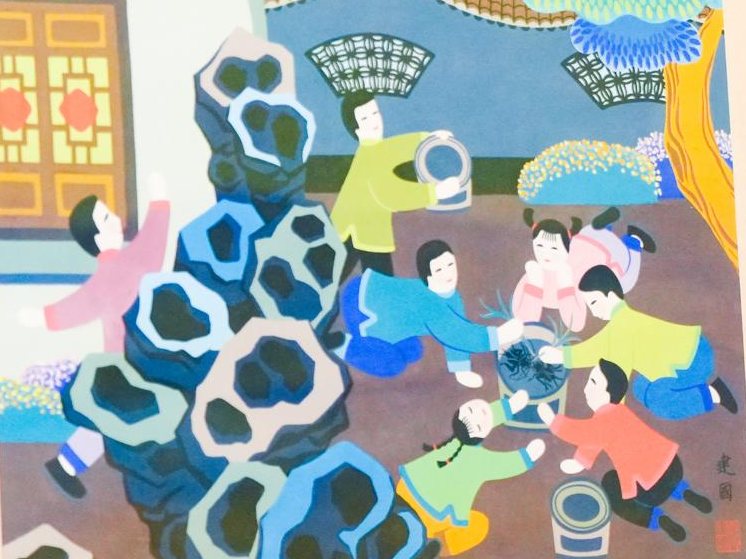
A Jinshan farmers' painting, shown at the 2026 salon
Where it starts
Jinshan, on the coastal edge of Shanghai
I was born in Jinshan, where my family has lived for generations, but I grew up in downtown Shanghai, and for a long time Jinshan was only a place name on my household register. Its farmers' paintings changed that: the kitchen stove, the silkworm trays and the sculling boats are how my grandparents really lived.
Summer 夏 · Research
Sky and soil
Research that is still growing: reading the sky from orbit, and sensing the air above the fields.
predicted contrailIllustrative
Fig. 1 · Same sky, infrared view; the model marks the contrail.
Research · Grade 9
Contrail detection from satellite imagery
An AI model (EfficientNetV2 + BiLSTM) that finds aircraft contrails in GOES-16 images, reaching about 70% Dice, to help reroute flights and cut non-CO₂ warming.
SASTIC Completed
fieldNH₃ map
NH₃ · ppm02.55
Illustrative
Fig. 2 · Drag to compare the field with the sensor map.
Research · Grades 11–12
Ammonia sensing for farms
A nanomaterial gas sensor for farm and factory air, validated in the field against gas chromatography.
IEEE-RICAI 2026 Under review
Learning along the river
Grades 9–12
AI Club, founder & president
Weekly machine-learning sessions in Python for 20+ members; ran Smart Cars on Campus; named Most Influential Club.
Grade 10
PACT
Program in Algorithmic and Combinatorial Thinking: a four-week intensive on the mathematical foundations of AI.
Grade 11 · UC Berkeley
AIRES
AI Research & Entrepreneur Scholars: AI engineering and innovation projects with Dr. Gillespie and Dr. Getz.
Autumn 秋
Harvest
What the work has yielded so far: a published paper and awards in heritage, engineering, programming and mathematics.
2026 · Harvest
Illustrative
No. 01 · Grade 11
Publication
Vision-guided robotic manipulation
A single-authored paper on robot manipulation guided by computer vision (YOLOv11Pose + ViT), published in the IEEE ICETCI 2026 proceedings and indexed in Compendex.
IEEE ICETCI 2026 · Published
秋
2026 · Harvest
No. 02 · Grades 10–11
Awards
AI for farmers' painting
Grand Prize (Craftsmanship & Heritage Award), National AI × Intangible Cultural Heritage competition. 2nd Place, Flying Dragon Division, WeChat Global Mini-Program Challenge (1,500+ entries).
Team AI Farmers' Painting
秋
2026 · Harvest
No. 03 · Grade 10
Award
Conrad Challenge China 2024–25
Best Innovation Award in Health & Nutrition, as leader of Team BioBot Innovators.
Best Innovation Award
秋
2026 · Harvest
No. 04 · Grades 10–11
Competition
USACO Platinum
Advanced to Platinum, the highest division of the USA Computing Olympiad, an international programming contest for high-school students.
Competitive programming
秋
2026 · Harvest
No. 05 · Grade 9
Competition
ARML 2023
National Gold and Global Top 100 Team in the American Regions Mathematics League Local Team Round.
Team mathematics
秋
Winter 冬
Field archive
Jinshan farmers' painting: the painters, the students and the village life around it.
Summer 2025 · China Art Museum, Shanghai
Guiding visitors through farmers' painting
Volunteer guide and workshop assistant at the First Exhibition of Chinese Farmer Paintings. With Jinshan painting masters I co-led three tours and workshops for more than 300 visitors.
Volunteer guide
21 Sep 2026 · Jinshan farmers' painting academy
Field interviews with the painters
I sat down with painters to record how they learned and how they work, and watched visitors try our AI mini-program, which turns a sentence or a photo into a picture in the farmers'-painting style.
Fieldwork
24 Sep 2026 · Farmers' painting salon
Six paintings, and why Jinshan
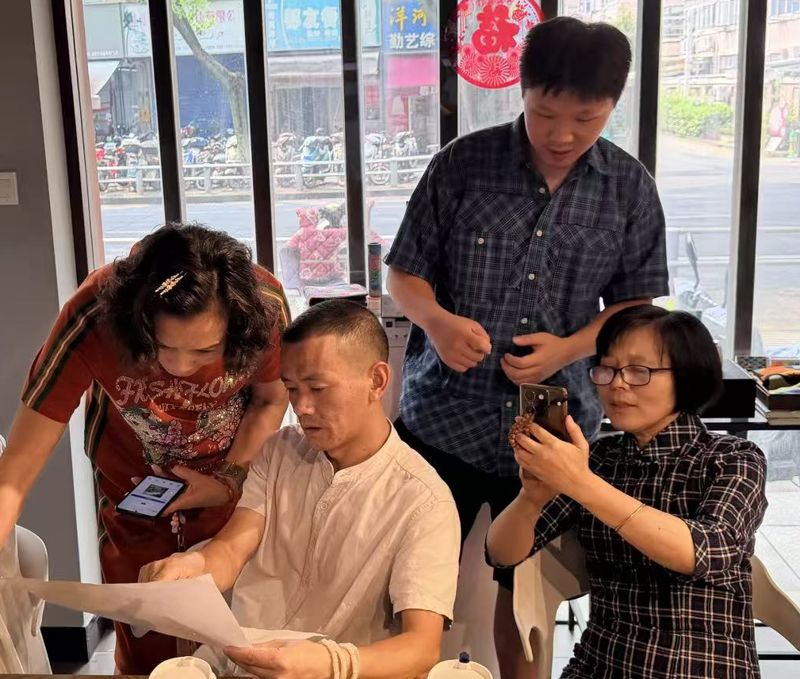
I hosted a salon where Jinshan painters brought six original works and told the stories behind them. I opened with why it matters to me: my family's roots are in Jinshan.
Host
10 Oct 2026 · Qianwei School, Jinshan
Back to the classroom
An outreach class for primary-school pupils: the painters showed their originals, and I introduced farmers' painting and the AI tool we built.
Outreach
Grade 11 · Seminars and paper
Dialogue between Human and Land
Seminars on farming cultures and harvest cycles, and a 2,000-word paper comparing Oaxaca's Day of the Dead with Jinshan's Qingming Festival. It builds on six years of teaching myself Spanish.
Illustration: the same sky in an infrared view, with a contrail marked.
Why
Contrails, the line-shaped clouds that aircraft leave behind, trap heat in the atmosphere. If airlines could see where contrails are forming, they could reroute flights around those regions and cut warming that has nothing to do with CO₂. The first step is simply to find them, reliably and automatically.
What I did
As lead researcher, I built a deep-learning model that finds contrails in images from the GOES-16 weather satellite. It pairs an EfficientNetV2 network, which extracts features from the images, with a BiLSTM.
Result
The model reached about 70% Dice, a measure of how closely its contrail masks overlap the labelled ones. The project was completed through SASTIC.
What's next
My later research on ammonia sensing stays with the air, but moves closer to the ground: from the sky above flight paths to the air above farms and factories.
Research · Grades 11–12
Ammonia sensing for farms
IEEE-RICAI 2026 Under review
Illustrative
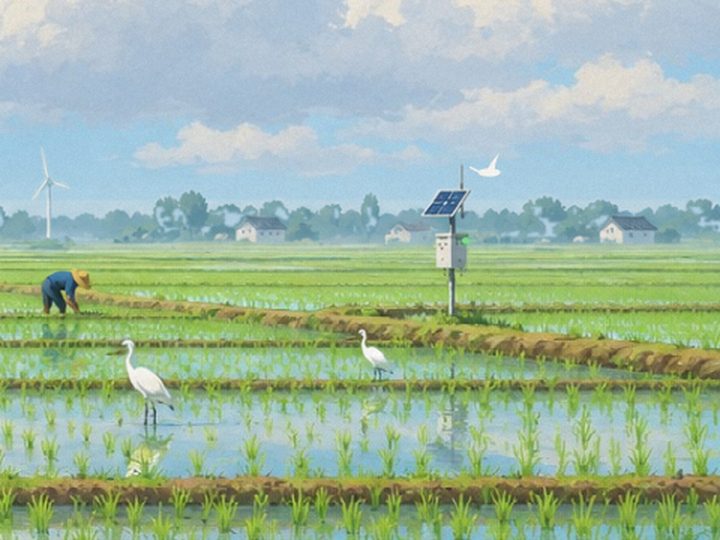
Illustration: a paddy field, where the sensor is headed next.
Why
Ammonia escapes from fertilised fields, livestock and factories. It harms the people who breathe it every day and helps form fine-particle air pollution. Cutting it starts with measuring it where it is released.
What I did
Working with Dr. Wang Xingwei at Tsinghua University, I developed a gas sensor made from a 2D nanomaterial composite. The material does more than detect small amounts of ammonia: it also conducts charge, which helps power the device. I then tested it on site in a factory in Shandong for several months, comparing its readings with gas chromatography (GC), the laboratory standard, and analysing the data for stability.
Result
Over the field validation the sensor stayed within 1% of GC. The paper is under review at IEEE-RICAI 2026.
What's next
So far the sensor has been tested in a factory; the next step is to test it on farms.
Publication · Grade 11
Vision-guided robotic manipulation
IEEE ICETCI 2026 · Published · Indexed in Compendex
Illustrative
Illustration: a detected object and the pose keypoints of a robot arm.
Why
A robot that picks up an object has to know more than where the object is: it needs the object's pose, so that the gripper meets it at the right angle. The same problem comes up wherever robots handle objects one at a time, from sorting parcels to picking fruit.
What I did
I wrote a single-authored paper on vision-guided manipulation. The method combines YOLOv11-Pose, which locates the object and its keypoints, with a Vision Transformer (ViT).
Result
The paper was published in the IEEE ICETCI 2026 proceedings and is indexed in Compendex.
What's next
Next, I want to apply the same approach to farm crops.
Project and awards · Grades 10–12 · Founder and project lead
AI for Jinshan farmers' painting
Grand Prize, National AI × ICH · 2nd Place, WeChat Global Mini-Program Challenge
Jinshan painters trying the tool at the painting academy, September 2026.
Why
Jinshan farmers' painting was born on stoves and village walls. Its painters never chased realism; they painted the work, harvests and festivals of their own lives. Today fewer people practise it. When I sat down with the painters, they told me how hard it is to earn a living from painting, and one who has painted for more than forty years said the art is declining again because people pay less and less attention to it.
What I did
I founded the AI × Jinshan Farmers' Painting Heritage Initiative. I interviewed three master painters and twenty participants, then built an AI WeChat mini-program that turns a sentence or a photo into a picture in the farmers'-painting style: painters can use it for new ideas about colour and composition, and students get a way in. I took it back to the painters and to local schools: three outreach sessions reached more than 100 students, and I wrote an essay for the school journal (100+ copies). When the children first saw the paintings, their eyes lit up.
Result
With Team AI Farmers' Painting, the project won the Grand Prize (Craftsmanship & Heritage Award) at the National AI × Intangible Cultural Heritage competition, and 2nd Place in the Flying Dragon Division of the WeChat Global Mini-Program Challenge, out of more than 1,500 entries.
What's next
The fieldwork goes on. In autumn 2026 I interviewed painters at the painting academy, hosted a salon where they showed six original works, and went back to a primary-school classroom. Those visits are in the winter archive, further along the scroll.


 predicted contrail
Illustrative
 Illustrative